

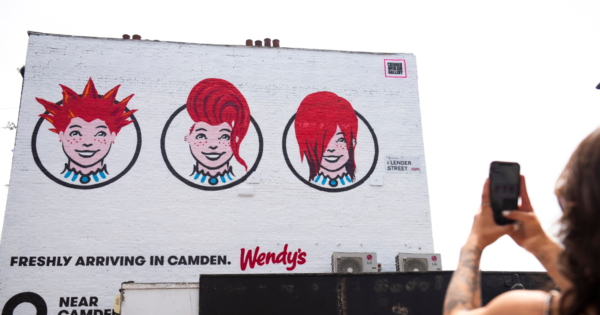


Since its U.K. relaunch in mid-2021, Wendy’s has opened 25 restaurants in the market, with sites in London, Sheffield and Brighton. Now, following a successful 18 months, it has ambitious plans to ramp things up with new spaces in Liverpool and Greater Manchester. The Republic of Ireland is also on the menu for 2023, with a blueprint to launch franchises on the European continent too.
The Ohio-founded chain’s most recent debut in the U.K. marked its third crack at the market following two previous unsuccessful forays. This time around, though, the burger brand has gained traction with a mix of tech-enabled stores and drive-thrus, reporting international sales (which includes the U.K.) to have grown 18.3% in the three months to November to reach $413 million.
The home of the Baconator picked the U.K. arm of VMLY&R, its longstanding U.S. agency partner, to helm its marketing strategy in the market. For Tony Barr, senior director of international marketing for Wendy’s, the focus has been on maintaining the brand’s challenger attitude while building an affinity with diners who might typically choose McDonald’s or Burger King.
“We’ve had to be genuine and authentic, and not just make noise for the sake of it,” he explained, during a recent session at Social Media Week Europe, saying a smart social strategy has been key to helping the brand take a big bite out of the U.K. market.
Firing up social media
If you’re one of the 3.9 million people that follow Wendy’s on Twitter, you’ll know it best for its quick-witted, savage replies. The brand’s grinning redheaded mascot can often be found digging into competitors and fans alike on the timeline: from calling a McDelivery van a “garbage truck” to clapping back at Gordon Ramsay on National Roast Day.
Barr said, prior to launch, his team conducted a lot of research into what people knew about Wendy’s and what they were excited about. While many were experiencing the chain for the first time, he said “many had already interacted with the brand on social.”
Using this as a starting point, the business enlisted VMLY&R London’s head of social Christina Miller to fire up a social-first launch strategy to drive cultural relevance. Miller decided to build upon the brand’s already strong foundation and adapt its “scale of sass” (or tone of voice) for Brits.
We think about awareness, reach, affinity and engagement and these things feed back into the decisions we make.
Tony Barr, senior director of international marketing, Wendy’s
“We asked what that looks like for British culture, British language, and we built something new to apply to how we talk to customers here,” she said, adding the brand’s prerogative on social was to “make new friends and invite them to lunch.”
Though it has found success with Twitter in the U.S., it has focused on building brand awareness and footfall through TikTok and Instagram in the U.K., where “more of its U.K. audience” can be found. On the latter, it’s been slowly cultivating a young, Gen Z and millennial community by reposting customer-created content and highlighting new stores as they open.
For Barr, it’s still early days, but Wendy’s has been measuring its social success in the U.K. by a mix of qualitative and quantitative testing.
“We think about awareness, reach, affinity and engagement and these things feed back into the decisions we make. We also want to make sure we have room to experiment and make new things. You don’t behave like a challenger brand by following everyone else’s playbook.”
It has also launched a dedicated U.K. Twitter account that references everything from London’s Notting Hill Carnival to the dismal British weather.
A local character
Beyond social, Wendy’s has been getting hyperlocal with its creative activations, which celebrate the U.K.’s distinct regional identities.
In June 2022, it gave its famous mascot a Camden twist, paying ode to the London borough’s eccentric art and music scene (which spawned the Sex Pistols and Amy Winehouse) by replacing Wendy’s pigtails with punk-inspired hair spikes, a flowing emo fringe and a bouffant quiff.
“That really caught people’s imagination,” said Barr. “It took off.”
Some ideas have taken the team back to the drawing board, though, said Miller, but it’s all about testing and learning.
“We had some ideas before we launched and one of them was to play off the Sunday Roast, which is a very big part of British culture. It hasn’t taken off quite as much as we want to. We still get people asking us to roast them here though, so there’s an appetite for it. We just need to find the right way to do it. Eventually, you’ll see something,” she said.
Barr said, for his marketers, there’s a fine line between wading into cultural or viral stories and knowing when to be reactive and when to hold back. The brand has already navigated its response to Covid-19 waves and Queen Elizabeth II’s death since it landed in the U.K.
“It’s about keeping our feet on the floor, and remembering that, at the end of the day, we’re just a burger brand,” she said. “We’re here to engage people and be entertaining. Sometimes, the time is not right to roast the competition. We have other ways to keep people interested in the brand.”
Source link


