


The first question David Hayman asks new people he meets is if they know where their pension money is held. Most say they don’t. If you’re reading this in the U.K., you might be surprised to learn that yours is most likely invested in fossil fuels, tobacco or arms. In the U.S., just 14 public pension funds inject $82 billion each year into coal, oil and gas.
Hayman is campaign director at Make My Money Matter, a movement started by Richard Curtis—better known as the co-founder of Comic Relief U.K. and director of films like Love Actually.
The nonprofit wants to bring more transparency to pension schemes across the world. It’s currently on a mission to educate people about what exactly their pension funds and encourage switching to providers that don’t fund deforestation among other things.

At the same time, it hopes to pressure big financial institutions to adopt more sustainable investment practices of their own.
“There’s an enormous gap between where the $3 trillion of U.K. pension payments are invested every year on people’s behalf goes, versus the lifestyle actions we make every day around the climate and the planet,” Hayman explained during a talk at Adweek’s recent Brandweek Europe event.
“We’re trying to help people understand the impact of their money and help them make positive financial decisions for the good of themselves and the good of the planet,” he added.
We’re trying to help people understand the impact of their money.
David Hayman, campaign director, Make My Money Matter
It’s not just pension providers that have a green problem. Each year, global banks spend millions on glossy advertising to frame themselves as friends to the planet, but unfortunately this isn’t always the case.
A marketing problem
In the U.K, the five of the most prominent high street banks funneled $141 billion to the 50 companies at the forefront of oil and gas expansion between 2016 and 2021.
More recently, HSBC was censured by watchdog Advertising Standards Authority ASA for “misleading” customers over green initiatives. The bank’s promotions around carbon offsetting, which ran during Cop26, didn’t add up, according to the organization. By the bank’s own admission, emissions related to clients it financially backed in 2021 stood at the equivalent of around 65.3 million tons of carbon dioxide per year for oil and gas alone.
Also trying to put a halt to greenwashed marketing is U.K. challenger The Co-Operative Bank.
The business hasn’t backed fossil fuel production for over 20 years, and in 2022 it launched a campaign urging people to ditch banks that support a range of unsustainable businesses, from Amazon logging to coal production.
“We want to lift the lid and provoke people to question what their money is doing, whether it’s the balances that sit in their savings or current account,” said Deborah Darlington, director of brand, marketing and communications at The Co-operative Bank.
Darlington said people’s paychecks are being used “in their trillions” to invest in projects that are damaging the environment, but also potentially funding oppressive regimes and projects that violate human rights issues: “The list goes on and on.”
A recent survey from the brand found that 70% of customers didn’t know where their savings were being invested, yet more than 50% wanted to be made aware.
Changing behavior
The Co-operative Bank’s commitment to remove itself from this system started 30 years ago with the launch of its customer-led ethical policy, which guides every business and marketing decision it makes. Darlington said the climate crisis consistently tops the list of things that matter to customers in regular surveys; they want their bank to protect the environment.
The company refuses to work with a lot of business clients based on these tenets, which is “tricky” at times.
The main challenge is ultimately driving change. Both brands are still early on in this journey, but in the last 12 months they’ve invested in creative campaigns to spread their message.
The Co-Operative bank is running a series of ads created by Denstu calling on people to “Withdraw From This,” showing images of grand bank buildings crumbling away to reveal the journey their bank notes have been on. They flutter through scenes of worldwide devastation caused by the fossil fuel industry, before finally being dispensed into the customer’s hands.
Working with Mother London, Make My Money Matter has taken a different approach, leaning on humor to drive awareness with a film showing the delivery of a “Deforester5000” and a dozen chainsaws to the doorstep of an unsuspecting couple. The delivery driver explains it’s from their pension provider. “For every £10 you put in your pension, £2 is linked to deforestation,” ends the witty spot.
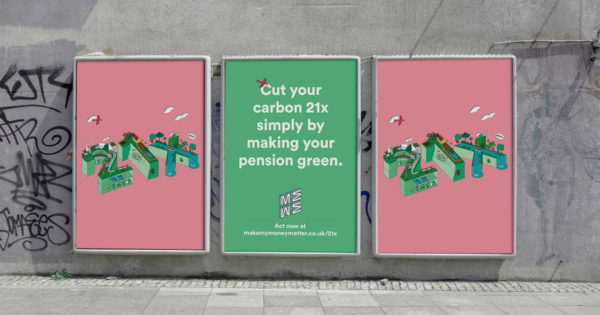
Other colorful billboards have aimed to showcase the nonprofit’s calculation that moving a pension into a greener fun can reduce someone’s carbon footprint 21 times more than going vegetarian or giving up flying.
Hayman admitted it can be a tricky brief, especially with the cost of living crisis top of consumers’ minds in a world where they’re already being “bombarded” by climate change messaging.
We need some form of accreditation or easy-to-spot logo or stamp that shows the work has been done for the consumer.
Deborah Darlington, The Co-operative Bank
“Pensions isn’t your natural place to go for campaigning around climate change, but we try and bring the two together,” he stated, pointing out that while people think pensions are just “something that happens in 50 years’ time” there is a need to communicate the immediate to short-term environmental impact they’re having now.
For Darlington, banking is a commodity and is meant to be “dull.” It’s also an industry built around “apathy” where people are reluctant to switch providers, even if it’s easy. These truths can bring their own challenges for her team.
Greenwashing guidelines
In the U.K market, the ASA’s ruling against HSBC is just the latest clampdown on greenwashing that has also landed Unilever and Oatly in hot water. However, some brands, including Innocent Drinks, have expressed concern that guidance is not clear enough.
Earlier this year, the World Federation of Advertisers issued a stark warning to brands that purport to be environmentally conscious for marketing purposes without making any notable sustainability efforts, issuing landmark guidance of its own.
However, consumers are still ultimately confused by what claims like “carbon neutral” and “net-zero” mean in the context of brand campaigns.
Where Darlington’s standing, there’s a fine balance between having tight regulations and “stiffing” smaller brands from entering the conversation entirely.
“For me, the most important thing would be having some form of accreditation or easy-to-spot logo or stamp that shows the work has been done for the consumer so they can make an informed choice. It’s easy to over-regulate, but sometimes it can cause more confusion,” she said.
“I would like there to be a review of brands can present information in an unbiased, unfiltered way,” she added.

In recent months, the new term “green-hushing” has made its way into discussions around corporate sustainability in reference to the rise of less public-facing communication of sustainability targets from big brands for fear of scrutiny, making progress harder to assess.
Hayman said these worries are “over-egged” by internal marketing teams at times.
“If you’re honest about the journey you’re on, you’re not going to get shut down,” he said.
Source link


